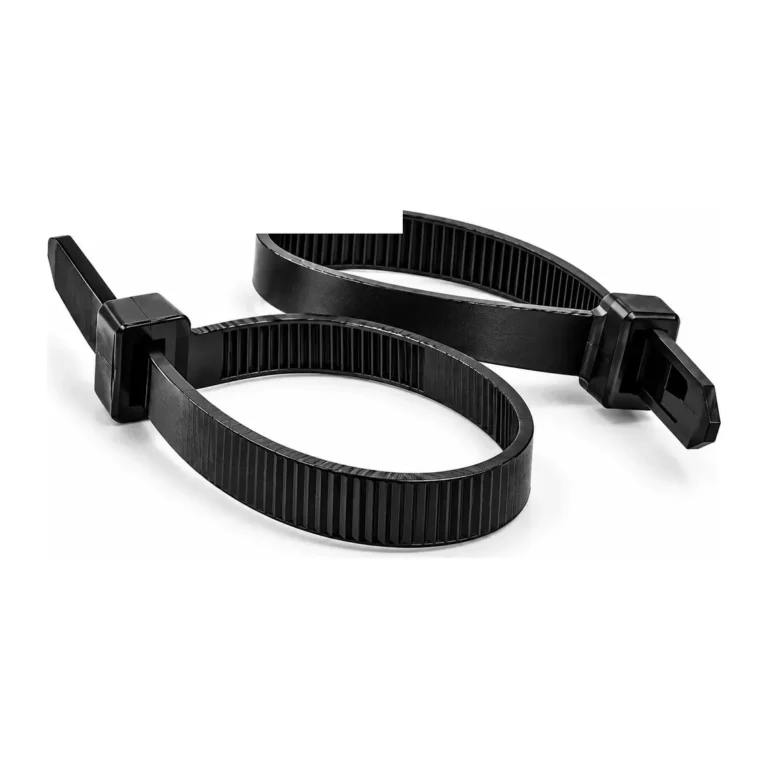
To choose a cable tie length, measure around the bundle, add about 50mm for the part that passes through the head and the tail you grip, then pick the next length up. Length only decides how big a bundle the tie will wrap. It does not change the strength: a 4.8 x 450mm tie holds the same 22kg as a 4.8 x 200mm tie.
Below is a simple measuring method, a bundle diameter chart for every length we stock, and tips for awkward shapes, growing bundles and very large jobs.
How do I measure a bundle for a cable tie?
Measure the distance around the bundle (the circumference) where the tie will sit, then add about 50mm.
- Wrap a piece of string, or a strip of paper, once around the bundle at the point where the tie will go.
- Mark where the string overlaps, then lay it flat and measure it. That is the circumference.
- Add about 50mm. Around 15 to 25mm of strap sits inside and beyond the head, and the rest is tail you can grip to pull tight.
- Choose the next tie length up from that number.
- Fit the tie, pull it tight, and trim the tail flush.
No string? Measure the bundle diameter with a ruler or tape and multiply it by 3.14 to get the circumference. A 50mm diameter bundle has a circumference of about 157mm, so add 50mm and you need a tie of at least 207mm: a 250mm tie, or a 200mm tie if you are happy with a very short tail.
What size bundle does each cable tie length fit?
As a rule of thumb, a tie wraps a round bundle with a diameter of a little under a third of its length, once you allow for the head and tail.
| Tie length | Approx. max bundle diameter | Typical bundle |
|---|---|---|
| 100mm | 22mm | A phone charger lead, a few data cables |
| 150mm | 35mm | A small loom, plant stakes, a hose to a tap |
| 200mm | 50mm | Most household and electrical bundles |
| 250mm | 65mm | Bigger looms, garden poly to a stake |
| 300mm | 80mm | Conduit pairs, poly pipe to a post |
| 370mm | 100mm | Fat looms, mesh to star pickets |
| 450mm | 125mm | Pipe groups, signs on poles |
| 530mm | 150mm | Fence posts, irrigation lines |
| 750mm | 220mm | Large pipe bundles, tree guards |
| 1220mm | 370mm | Posts, poles and the largest bundles |
These figures allow for a normal tail. Head designs vary slightly between widths, so leave some margin. For flat or square bundles, measure the perimeter rather than using diameter.
Is it better to go too long or too short?
Too long is always better. A tie that is too long just leaves a longer tail to trim. A tie that is too short either will not close, or closes with only a couple of teeth through the pawl, which is the weakest way a tie can be fitted.
If you are between two sizes, choose the longer one. Trim the tail flush after tightening so it does not catch on hands, clothing or other cables. A cable tie gun tensions and cuts flush in one squeeze.
How do I size ties for odd shapes?
- Flat bundles (ribbon cable, flat poly): measure the perimeter, which is about twice the width plus twice the thickness.
- Square posts and timber: add the four sides together. A 90 x 90mm post needs about 360mm plus 50mm: a 450mm tie.
- Pipe to a post: wrap the string around both together, as one loop.
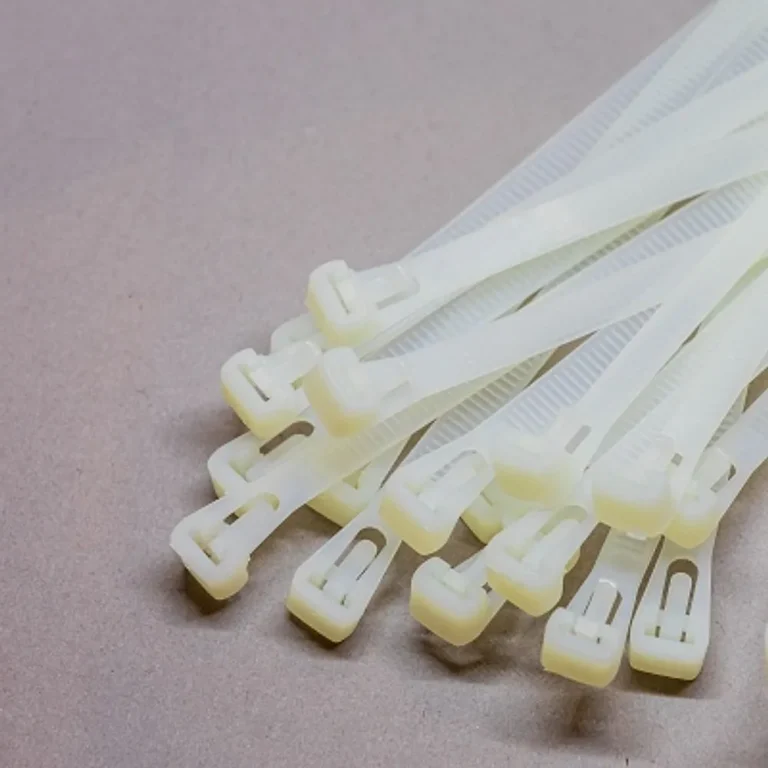
- Bundles that will grow: allow room for extra cables or a growing stem. Choose a length that still has a good tail when the bundle is at its largest, or use releasable ties.
- Mesh and shade cloth: the tie goes through the mesh and around the wire or frame, so measure that loop, not the whole post.
Can I join two cable ties for a big bundle?
You can daisy-chain two ties by threading the tail of one through the head of the other, but the joint becomes the weak point and the bundle tends to twist.
It is fine for a light, one-off job. For anything that matters, buy the right length. Our 9mm black cable ties run from 530mm to 1220mm, and our 7.6mm black cable ties from 200mm to 750mm, so most large bundles are covered by a single tie.
Once I know the length, how do I pick the width?
Pick the width by the load. Width sets the breaking strain: 2.5mm (8kg), 3.6mm (18kg), 4.8mm (22kg), 7.6mm (55kg) or 9mm (80kg).
Lengths are linked to widths, because long thin ties are hard to tension. In our range, 2.5mm ties run 100 to 200mm, 3.6mm run 150 to 300mm, 4.8mm run 200 to 450mm, 7.6mm run 200 to 750mm and 9mm run 530 to 1220mm. If the length you need only comes in a wider tie, that is usually the right tie for the job anyway. See cable tie widths explained and the size and strength guide, or filter all cable ties by width and length together.
Quick answers
What length cable tie do I need for a 50mm bundle?
A 50mm round bundle has a circumference of about 157mm. Add 50mm and choose the next size up: a 250mm tie gives a comfortable tail, and 200mm is the minimum.
Does a longer cable tie hold more weight?
No. Strength comes from the width. A 4.8mm tie is rated at 22kg whether it is 200mm or 450mm long.
How much tail should be left before cutting?
Leave enough to grip and pull tight, usually 30 to 50mm, then trim flush after tensioning.
What is the longest cable tie you sell?
Our 9mm black cable ties go up to 1220mm, which wraps a bundle up to about 370mm across.