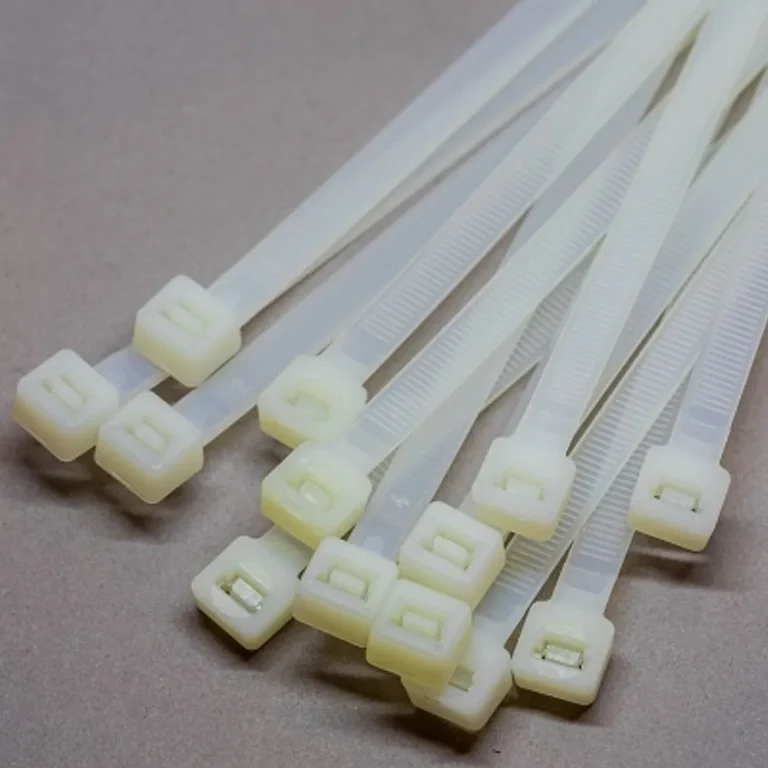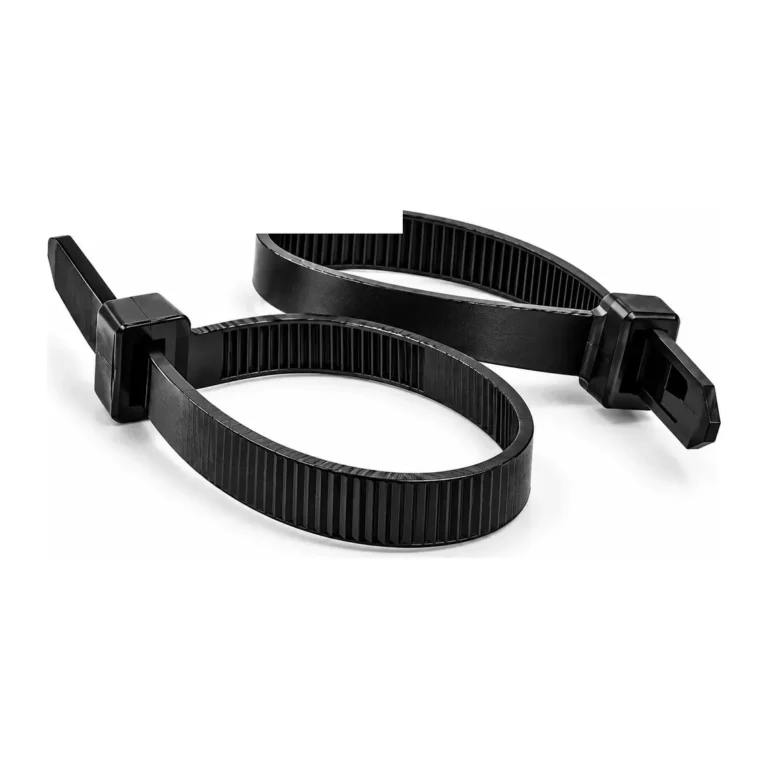
Nylon 66 is the better material for cable ties. It has a higher melting point, keeps its stiffness and strength better when warm, and absorbs less moisture than nylon 6, which is why it is the standard for electrical-grade ties. Nylon 6 is slightly cheaper and a little more flexible, but softens sooner in heat. All of the nylon cable ties we sell are nylon 66.
Here is what the two grades mean on a real job: heat, moisture, sun, cold, fire and how to tell what you are buying.
What is the difference between nylon 6 and nylon 66?
Both are polyamides (PA6 and PA66). They are made from different raw materials, which gives nylon 66 a tighter, more crystalline structure and better heat resistance.
| Property | Nylon 66 (PA66) | Nylon 6 (PA6) | What it means for a tie |
|---|---|---|---|
| Melting point | About 260°C | About 220°C | PA66 keeps its shape and grip at higher service temperatures |
| Stiffness when warm | Higher | Lower | PA66 ties hold tension better in hot roof spaces and enclosures |
| Moisture uptake | Lower | Higher | PA6 ties can be softer and slightly weaker in humid conditions |
| Flexibility when cold | Good once conditioned | Slightly better | Both need care when fitted in frost |
| Cost | Higher | Lower | Very cheap ties are more likely to be PA6 or blends |
| Typical use | Electrical-grade cable ties | General purpose and low-cost ties | Look for PA66 for wiring and long-life jobs |
How does heat affect nylon cable ties?
Heat is where nylon 66 earns its place. It melts at around 260°C, compared with around 220°C for nylon 6, and more importantly it keeps more of its strength at the warm end of normal service.
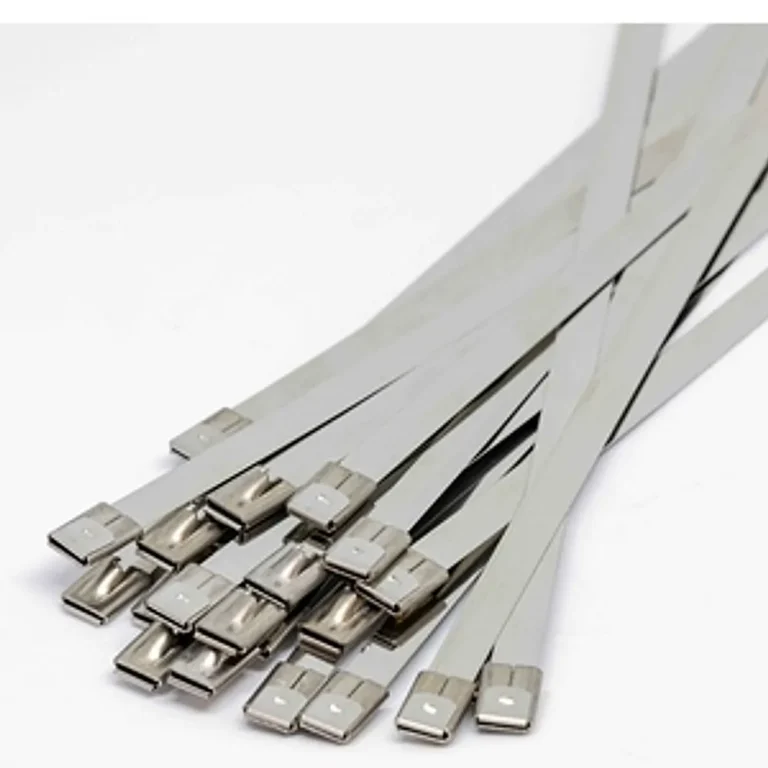
Typical nylon 66 cable ties are used from about -40°C to 85°C. That covers a ceiling space in an Australian summer, the inside of a switchboard or control cabinet, and most of an engine bay away from the exhaust. Near exhaust manifolds, turbos, heaters or any surface that runs above about 85°C, neither grade is suitable. Use stainless steel cable ties, which will not soften or melt.
Does moisture weaken nylon cable ties?
Nylon absorbs a small amount of water from the air, and that is normal. In fact, a little moisture keeps a tie flexible; a bone-dry tie straight from a hot store room is more brittle.
Nylon 6 absorbs more water than nylon 66, which can make it softer and slightly weaker in very humid conditions, such as in the tropics or in wet plant rooms. If ties feel stiff or brittle after storage in a hot, dry place, keep them in their bag and give them a day in normal air before a big job. More on this in do cable ties go brittle?
Is nylon 66 UV resistant?
No. Neither grade is UV resistant on its own. What protects a tie outdoors is UV stabilisation, usually carbon black, added when the tie is moulded.
That is why black cable ties are the choice for outdoor jobs, and natural white or coloured ties are best kept indoors or out of direct sun. Read are black cable ties UV resistant? for how long each type lasts in the Australian sun.
Are nylon 66 cable ties fire rated?
Electrical-grade nylon 66 ties are commonly rated UL94 V2, which means the material stops burning within a short time once the flame is removed. It does not mean the tie will survive a fire.
In fire-rated escape routes, plenums and some commercial ceilings, the job specification may require metal fixings that will not drop cables in a fire. Check the specification and use stainless steel ties where it asks for them.
How can I tell which nylon my cable ties are?
Quality ties say so: look for “nylon 66” or “PA66” on the bag, the listing or the data sheet. If a listing just says “nylon”, “plastic” or nothing at all, assume it could be nylon 6 or a blend.
Other signs of a cheap tie are a thin, flimsy head, a pawl that does not click cleanly, a strap that whitens when you bend it, and a breaking strain that is not stated. Every nylon tie in our range is nylon 66, and the width (and so the strength) is in the product name.
Which cable ties should I choose?
- Indoor electrical, racks, switchboards: nylon 66 in white or black, 2.5mm to 4.8mm.
- Outdoors in the sun: UV-stabilised black nylon 66.
- Heat above about 85°C, salt spray, chemicals or a very long service life: stainless steel.
- Colour coding: colour cable ties are nylon 66 too, with the same strength per width.
Once the material is right, choose the width for the load with the size and strength guide.
Quick answers
Are nylon 66 cable ties stronger than nylon 6?
At room temperature they are similar for the same design. Nylon 66 keeps more of its strength as temperature rises, which is what matters on most jobs.
What temperature can nylon 66 cable ties handle?
Typically about -40°C to 85°C in service. Above that, use stainless steel ties.
Are your cable ties nylon 66?
Yes. Every nylon cable tie we sell is nylon 66, in black, white and colours.
Do black nylon 66 ties last longer outdoors?
Yes. The carbon black UV stabiliser in black ties protects them from sunlight far better than natural or coloured nylon.