The kilogram figure on a cable tie is its breaking strain: the steady pull, in good test conditions, at which the tie fails. It is not a safe working load. As a working rule, choose a tie rated at least twice the load it will hold, and go wider again where there is vibration, sharp edges, heat or years of sun.
This guide explains how cable ties are rated, why real jobs are harder than the test, how to pick a width with a sensible margin, and what cable ties should never be used for.
What does the kg rating on a cable tie mean?
The kg rating is the loop tensile strength: the load at which a closed loop of the tie breaks or the head lets go when pulled steadily apart.
Our nylon 66 ties are rated by width: 2.5mm at 8kg, 3.6mm at 18kg, 4.8mm at 22kg, 7.6mm at 55kg and 9mm at 80kg. The test is done on new ties, at room temperature, with a slow, even pull. That is useful for comparing one tie with another, but it is the best case, not the everyday case.
Why do cable ties fail below their rating?
Most cable tie failures on real jobs happen at a fraction of the rated strain, because one or more of these conditions apply:
- Vibration and movement. A bundle on a trailer, machine or fence line in the wind loads and unloads the tie thousands of times. Repeated loading wears the pawl and strap and fails a tie well below its static rating.
- Sharp edges. A burr on steel, the edge of a sheet-metal bracket or a cut star picket concentrates the load on a few millimetres of strap and can slice through nylon.
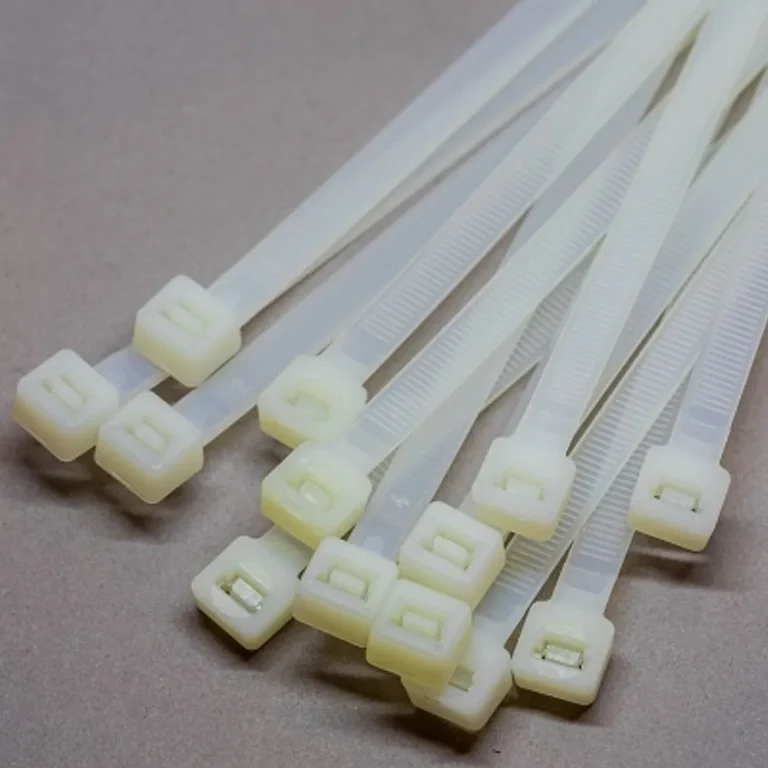
- Sun and heat. UV light and high temperatures slowly break down nylon. Natural white ties outdoors lose strength fastest.
- Cold and impact. Nylon is less flexible in the cold and can crack if struck, for example by a mower or a gate.
- Poor tensioning. A loose tie lets the bundle move and rub. An over-tensioned tie is already carrying load before the job starts.
- Off-axis loading. A tie loaded across the head, or twisted, fails sooner than one pulled straight.
How much margin should I allow?
Choose a tie whose breaking strain is at least twice the load it will hold, and step up one more width when any of the conditions above apply.
| Load on the tie | Minimum breaking strain (2x) | Suggested width | Harsh conditions |
|---|---|---|---|
| Up to 4kg | 8kg | 2.5mm | 3.6mm |
| Up to 9kg | 18kg | 3.6mm | 4.8mm |
| Up to 11kg | 22kg | 4.8mm | 7.6mm |
| Up to 27kg | 55kg | 7.6mm | 9mm |
| Up to 40kg | 80kg | 9mm | 9mm x 2, or stainless |
“Load on the tie” is the force trying to open the loop, not the weight of the whole object. A sign hung with four ties shares its weight, but wind can put most of the load on one tie at a time, so size each tie for more than a quarter of the weight.
How can I get more holding power?
- Go wider, not longer. Length never adds strength. A 7.6mm tie is more than twice as strong as a 4.8mm tie.
- Use more ties. Two or three ties spaced along a run share the load and stop the bundle twisting.
- Protect the strap. File burrs, pad sharp edges with a scrap of hose, or use a cable tie mount to keep the strap off the edge.
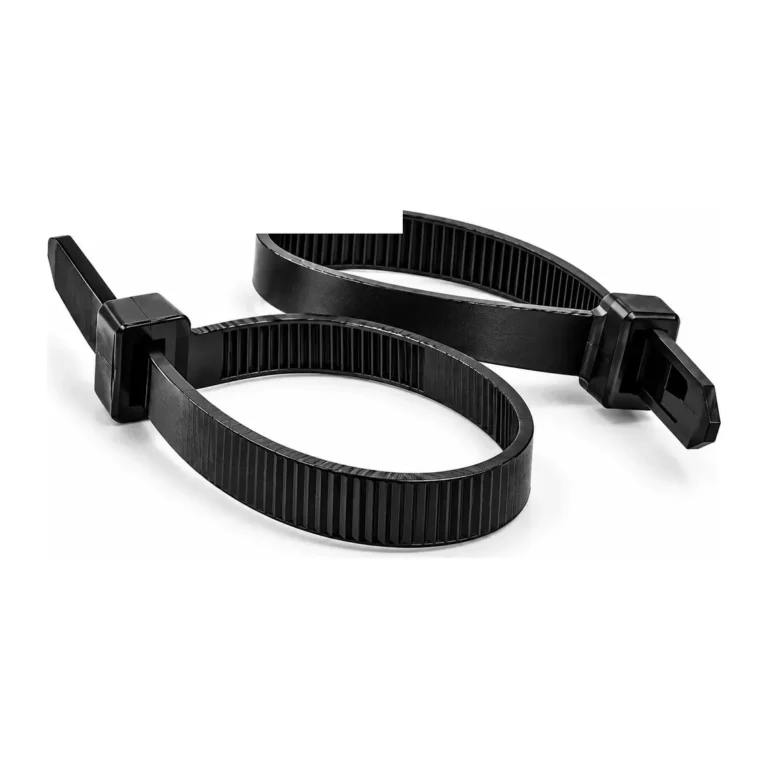
- Choose the right colour outdoors. Black cable ties are UV stabilised and keep their strength far longer in the sun.
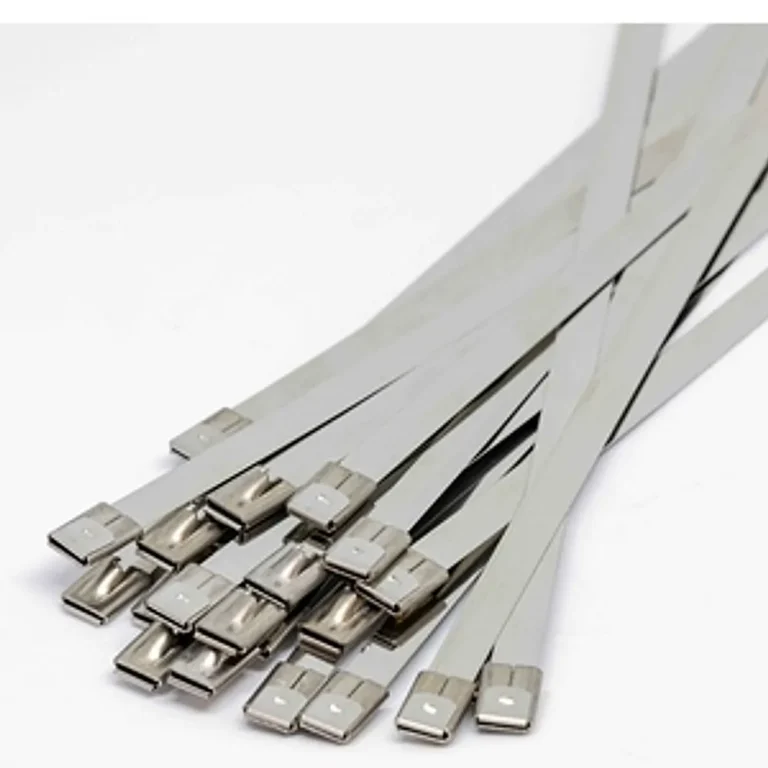
- Change material. Stainless steel cable ties keep their strength in heat, sun and salt where nylon would degrade.
- Tension properly. Snug, not strangled. A cable tie gun gives the same tension every time.
Does temperature change the rating?
Yes. Nylon 66 ties are generally used from about -40°C to 85°C, but they are strongest in the middle of that range.
In a hot roof space or engine bay, nylon softens and stretches more under load. In frost, it is stiffer and more likely to crack if knocked. Near exhausts, turbos or any surface above about 85°C, nylon is the wrong material; use stainless steel. More in do cable ties go brittle?
What should cable ties never be used for?
Cable ties are holding fasteners for bundling and securing. They are not rated lifting, restraint or structural fixings.
Never use them to lift loads, to hold anything overhead where a failure could drop it on someone, to restrain people or animals, as a tow or tie-down for vehicle loads, or in any place where a failure could cause injury. Use rated slings, shackles, ratchet straps and structural fixings for those jobs.
Where can I see the rating for each tie?
The width is in every product name, and the size and strength guide lists the breaking strain for each nylon width. To understand how width relates to strength in more detail, read cable tie widths explained, then browse all cable ties by width.
Quick answers
Is breaking strain the same as tensile strength?
For cable ties the terms are used for the same figure: the loop tensile strength at which a new tie fails under a steady pull.
How much weight can a 4.8mm cable tie hold?
Its breaking strain is 22kg. For a steady load, plan on no more than about 11kg per tie, and less with vibration or sharp edges.
Are two cable ties twice as strong?
Close to it, if they share the load evenly and are spaced apart. Two ties side by side on the same spot do not always load equally.
Are coloured cable ties weaker than black?
No. Ties of the same width and material have the same rating. Black ties simply last longer in sunlight.