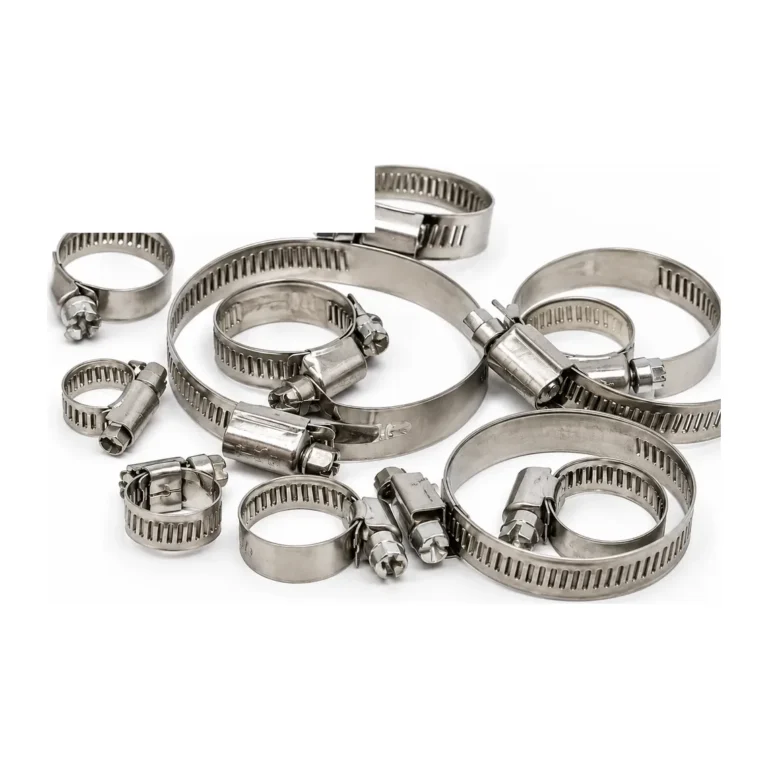
To size a hose clamp, push the hose onto its fitting, measure the outside diameter of the hose where the clamp will sit, and choose a clamp whose range puts that measurement near the middle. That leaves room to tighten as the hose compresses, and to re-tighten later. Hose clamps are sold by clamping range, such as 20 to 35mm.
This guide covers how to measure, how to choose the range, common hose sizes, and how to tighten correctly.
What does the size on a hose clamp mean?
A hose clamp is sold by its clamping range: the smallest and largest outside diameter it can close around. A 20 to 35mm clamp will tighten onto anything from 20mm to 35mm across.
Get it right and the clamp seals with room to spare. Get it wrong and it either will not close around the hose, or it bottoms out (runs out of thread) before it is tight.
How do I measure a hose for a clamp?
- Fit the hose onto the barb or pipe first. Hose stretches over a fitting, so measure it there, not loose.
- Measure the outside diameter with vernier callipers where the clamp will sit, just behind the end of the hose and over the barb.
- No callipers? Wrap a strip of paper around the hose, mark the overlap, measure the length and divide by 3.14.
- Write the measurement down in millimetres before you look at clamp ranges.
Do not size from the inside diameter printed on the hose. A 25mm ID hose can measure 33mm or more outside, depending on the wall thickness, and more again once it is stretched over a fitting.
How do I choose the right clamp range?
Pick a range where your measurement sits near the middle. If your hose measures 28mm, a 20 to 35mm clamp is better than a 25 to 40mm clamp, because 28mm sits in the middle third of the first range.
- Near the bottom of a range: the clamp may run out of thread before it is tight. Go down a range.
- Near the top of a range: the clamp may be hard to start and has little spare band. Go up a range.
- Between two ranges: choose the one that puts your measurement closest to the middle.
What clamp suits common hose sizes?
| Hose (outside diameter on fitting) | Suggested German clamp range |
|---|---|
| 9mm fuel or vacuum | 6 to 12mm |
| 13mm heater hose | 10 to 16mm |
| 16mm hose | 12 to 20mm |
| 25 to 30mm radiator hose | 20 to 35mm |
| 45mm intake hose | 34 to 57mm |
| 60mm intercooler hose | 50 to 70mm |
| 75mm ducting | 60 to 80mm |
These are typical; always measure your own hose. Shop German 304 hose clamps from 6mm to 130mm and, for fuel injection, EFI clamps for 6 to 16mm hose.
How tight should a hose clamp be?
Snug the clamp, then tighten a little more until the hose is firmly gripped and will not turn on the fitting. Do not crank it until the hose bulges either side of the band or the band cuts in. Over-tightening damages the hose and can crack plastic fittings.
Re-check after the first heat cycle or a few days of use, because hose settles. A flexible 7mm hex driver makes clamps in tight spots easier to reach and tighten evenly.
What are common sizing mistakes?
- Measuring the hose before it is on the fitting.
- Sizing from the hose inside diameter.
- Choosing a range with the hose right at the bottom, so the clamp bottoms out.
- Using one clamp size for both ends of a hose that fits different-sized pipes.
- Placing the clamp past the barb, where it squeezes hose onto nothing.
Which type of clamp should I use?
For most hose, a German pattern clamp with a solid band; for fuel injection, an EFI clamp. The comparison is in German pattern vs worm drive vs EFI hose clamps. On boats, see marine wiring: ties and terminals.
Quick answers
Do I measure the inside or outside of the hose?
The outside diameter, with the hose fitted on the barb or pipe.
What if my hose is between two clamp sizes?
Choose the clamp range that puts your measurement closest to the middle.
Why will my hose clamp not tighten?
It has probably bottomed out because the range is too big. Use the next range down.
What hose clamp do I need for a 25mm radiator hose?
Measure it on the fitting; most measure about 30 to 35mm outside, so a 20 to 35mm or similar range usually suits.