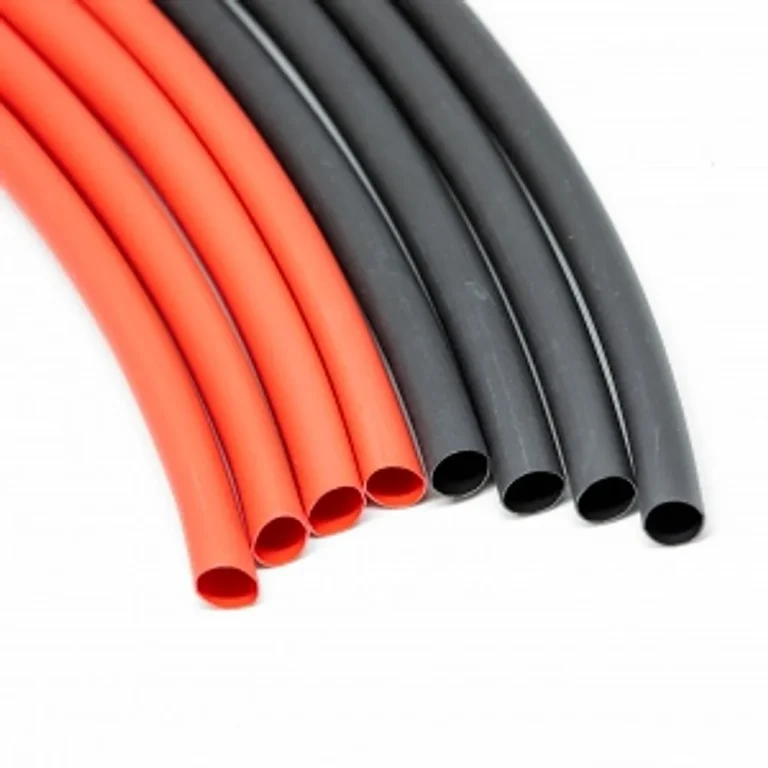
Single wall heat shrink insulates and tidies a join but does not seal it. Dual wall heat shrink has an inner layer of hot-melt adhesive that melts as the tube shrinks and seals the join against water, dirt and salt. Use single wall for dry, indoor joins and dual wall for anything that could ever get wet: automotive, trailer, marine, solar and outdoor wiring.
Below: how each type works, a comparison table, the jobs that suit each, and how to shrink dual wall so it actually seals.
What is single wall heat shrink?
Single wall heat shrink is a single layer of polyolefin tube. Heated, it shrinks tight around the join to insulate it, tidy it and add a little mechanical protection.
It does not seal. Water can wick along the wire and under the tube, especially on a join that is bent or moves. Our single wall heat shrink runs from 3mm to 16mm, sold by the metre.
What is dual wall heat shrink?
Dual wall (adhesive-lined) heat shrink is an outer polyolefin tube with an inner layer of hot-melt adhesive. As the tube shrinks, the adhesive melts and flows into the gaps between strands, terminal and insulation, then sets to form a seal.
It is also thicker, so it adds strain relief where a wire meets a terminal or lug. Our 3:1 dual wall heat shrink runs from 2.4mm to 90mm, sold by the metre.
Single wall vs dual wall at a glance
| Single wall | Dual wall (adhesive) | |
|---|---|---|
| Layers | One polyolefin layer | Polyolefin outer, hot-melt adhesive inner |
| Insulates | Yes | Yes |
| Seals against water | No | Yes |
| Strain relief | Light | Good |
| Shrink ratio (our range) | About 2:1 | 3:1 |
| Flexibility after shrinking | More flexible | Stiffer |
| Cost per metre | Lower | Higher |
When is single wall heat shrink enough?
- Indoor and always-dry joins, such as inside appliances and enclosures.
- Bundling and colour marking wires.
- Tidying cable ends and sleeving tool handles.
- Joins that must stay flexible.
- Jobs where cost per metre matters and water is not a risk.
When do I need dual wall heat shrink?
- Automotive, 4WD, trailer and caravan wiring.
- Marine wiring and anything near salt water.
- Outdoor, solar, garden lighting and irrigation joins.
- Anything that will see rain, a hose or a pressure washer.
- Battery lugs and terminals that need strain relief.
- Underground or buried joins, as part of a proper sealing method.
For vehicle and boat work in detail, see cable ties for cars, 4WDs and trailers and marine wiring: ties and terminals.
How do I shrink dual wall heat shrink properly?
- Slide the tube onto the wire before you crimp or solder.
- Make the join, then centre the tube over it with at least 10mm overlap onto the insulation each side (15 to 20mm for wet locations).
- Heat from the middle outwards with a heat gun, turning the work so it heats evenly and pushes air out of the ends.
- Keep heating until the tube is tight and a small bead of adhesive shows at each end. No bead usually means no seal.
- Let it cool fully before bending or loading the join.
A lighter scorches the tube and heats unevenly, so the adhesive may not melt all the way round. Use a heat gun.
What about heat shrink wire joiners?
Heat shrink wire joiners combine a butt crimp and an adhesive heat shrink sleeve in one part: crimp both wires, then heat to seal. They are the quickest way to make sealed joins on vehicle and marine looms. See how to crimp insulated terminals.
How do I pick the size?
Measure the widest part of the join and the wire insulation, and choose a tube that slides over the first and shrinks smaller than the second. Full method in how to choose the right heat shrink size.
Quick answers
Is dual wall heat shrink waterproof?
Properly shrunk adhesive dual wall seals the join against water. Look for a bead of adhesive at each end.
Can I use single wall heat shrink outdoors?
It will insulate, but water can get under it. Use dual wall for anything outdoors or wet.
Why is dual wall heat shrink stiffer?
The adhesive layer sets hard after cooling, which seals the join and adds strain relief.
What ratio is dual wall heat shrink?
Our dual wall heat shrink is 3:1, so it shrinks to about a third of its supplied diameter.